
Fourteen years.
It has been fourteen years since… Well, we do not speak of it.
My name is Lazarus Blackthrone. I provide for my mother and my younger sister, Gwen, who has recently come of age and entered the marriage mart. I am the son of the scholar Theodore Blackthrone, who now lives with the woman for whom he abandoned my mother. They have two children together—my half siblings, Augustus and Celine—but I barely know them.
I left home not long after my family fell apart, guiltily leaving Gwen to manage our household and care for our frail mother. Although my father remained principled enough to continue providing some financial support, his income—and his loyalty—was now divided between two families. As the man of our household, it fell to me to earn the money needed to keep ours afloat.
His disloyalty left a bitter taste in my mouth and shattered any hope I had of an ordinary future. At five-and-twenty, I found myself responsible for my mother’s household, with no title, little money, and no family name of consequence.
Unfortunately, the road to doing so has not been pleasant.
One of my earliest ventures was an investment in a speculative enterprise that failed to produce the promised returns. Later, I opened a tavern, which failed miserably and left me deeply in debt. With few options remaining, I accepted a position at Cabot & Co., where I met Mr. Ashton Cabot, a gentleman of respectable standing who took me under his wing.
Cabot & Co. was a debt-collection and bill-brokerage firm, but its dealings were principled. The company worked with businesses rather than individuals, restructuring struggling factories with the intention of keeping them operating and their workers employed. Mr. Cabot possessed an eye for talent and a nose for business. He taught me what to notice, what to question, and how to follow the flow of money.
He remained my mentor until the day he told me I needed to leave.
“This is not the place for you, Laz,” Mr. Cabot said kindly. “You are a handsome young man with an eye for detail and a gift few possess. Your talents would be better served in trade among the elite—particularly among wealthy noblewomen.”
I bristled at the mention of my gift and my appearance, but I could not argue with his reasoning.
I was not always considered handsome. I was an awkward boy who eventually grew into his features. Yet my lack of title and fortune meant that the finer ladies at court would not have me, while the young women of my village could never see beyond the boy they had once mocked.
When I finally left home and ventured into the wider world, however, I encountered no shortage of women eager to entertain me. Some were bored and lonely wives of wealthy nobles or merchants who were willing to make me their bedmate. At first, I admit, the attention flattered me—particularly when it came with money and gifts. Over time, however, I began to resent it. I was rarely treated as a man. I was an accessory to be displayed when convenient and hidden when I became inconvenient. I was either instructed to remain silent or reminded of my station.
Eventually, the attention left me bitter.
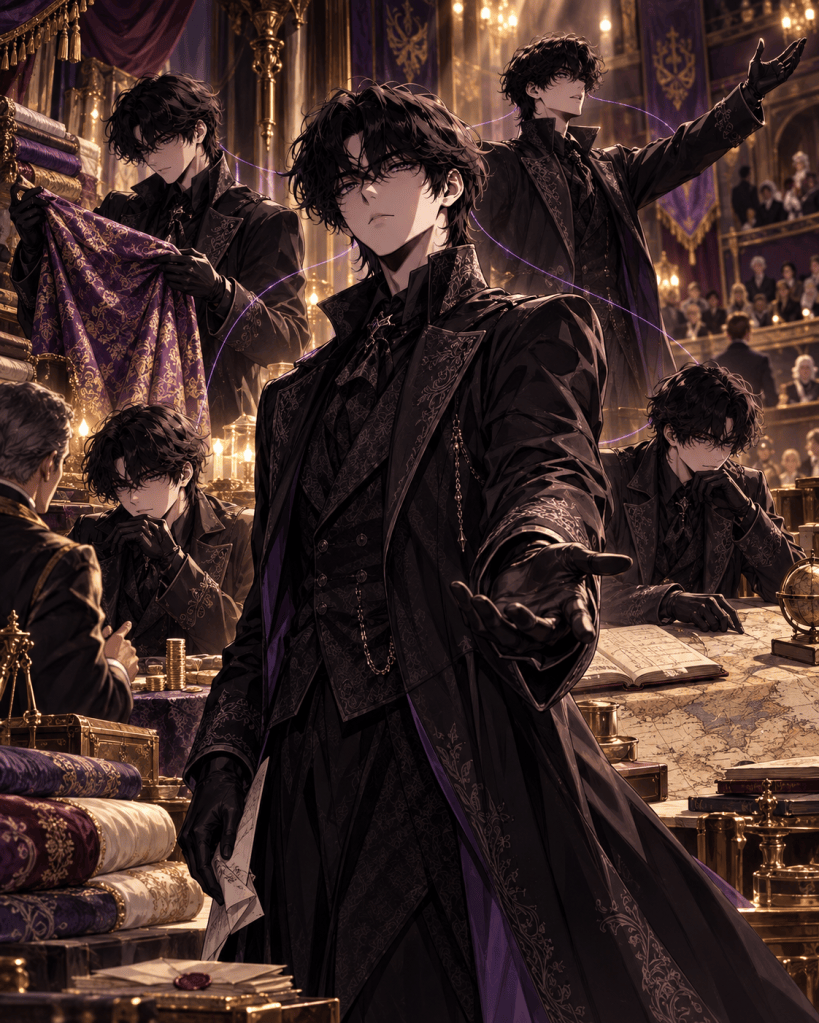
As for my gift, I was born with a rare ability: I can divide myself into identical versions of myself. Each body can speak, reason, and act independently, but all remain connected through one shared mind. Anything witnessed or learned by one is immediately known by the others. Five is the greatest number I have ever attempted to maintain at once.
The cost is physical strength. The more bodies I create, the weaker each of them becomes. Any pain or injury suffered by one is shared by all.
I cannot farm with the strength of three men, but I can conduct negotiations, research markets, and purchase goods as three separate men in three different places at the same time. Because we share a single mind, I have no need to wait for the others to return before acting upon what they have learned. It is an invaluable advantage in trade.
Because of the physical demands of my ability, I take great care to remain fit. The last thing I want is to be ambushed by rogues while divided and find myself unable to fight back. Besides, I would rather send the coin I might pay to hired guards home to my mother and sister. Thankfully, only a rare few know how vulnerable duplication leaves me.
Before I departed Mr. Cabot’s employ, he gave me a letter of introduction to Lord Roan Dun in the neighboring kingdom of Yvesworth. Lord Roan was a remarkably gifted merchant who became my second mentor. He taught me how to study my clients, anticipate the needs of the market, recognize the proper moment to buy, and price both my goods and my talents accordingly.
I spent the better part of eight years at his side—five as his apprentice and three as his associate. After his wife died, Lord Roan chose to retire and return to his hometown, where he intended to spend his remaining years with his grandchildren.
I now oversee his book of business, but his retirement has drawn the attention of new competitors eager to claim his place. They see me as weak, inexperienced, and largely unknown. Despite my eight years under Lord Roan’s guidance, I remain a small fish in a very large pond.
The truth is, although I am a merchant—and the work suits my natural talents—I do not look like a successful one. Because I send most of my earnings home to my mother and sister, I maintain a modest household and dress plainly. My unassuming appearance helps keep thieves from identifying me as a worthwhile target, but it also puts off noble clients accustomed to the jewels, finery, and pageantry common among merchants of my standing.
When the Challenges of Wit were introduced, I became intrigued. The prize money alone made the competition enticing. It offered free publicity for my business and the possibility of earning additional coin to cover my mother’s healer’s fees and build Gwen’s dowry.
Ironically, the very thing I most hated exploiting—my appearance—was what set me apart during the matches.
Years spent dealing with nobles, their wives, and wealthy customers had taught me how to wield charm when necessary. The Challenges marked the first time I had ever done so before such a vast audience. My popularity grew further when the ladies discovered that I could duplicate myself. The ability intrigued them, and more than a few offered me private audiences in which they hoped to explore their darker carnal appetites.
I accepted none of those invitations.
Nevertheless, many of my patrons were widows, lonely women of means, and young ladies of high standing. My trade naturally attracted a substantial female clientele. I dealt primarily in cotton, silk, lacquered fabrics, linen, and wool, selling bolts of cloth to tailors and modistes, as well as materials for bedding, draperies, tablecloths, and napkins.
What no one knows is that, despite all the coin I earn, it never seems to be enough.
Even with my household kept lean, I am still paying the debts left by my earlier ventures, my mother’s healer’s fees, and the expenses of Gwen’s debut. Some days, I feel as though I am drowning.
Under these circumstances, I cannot take a wife. Supporting one would divert money from the family already dependent upon me, and that is simply not possible. Perhaps Gwen will win the favor of a nobleman. We have no title to offer him, but if I can make her dowry impressive enough, she may still secure a suitable match. Once she is settled, I will no longer have to worry about her future. Then there will only be my mother and her estate to maintain.
Perhaps, when that day comes, I will finally be able to consider a future of my own.
But I am quickly approaching forty. By the time my obligations are settled, I may find myself facing an entirely different question: What woman would still have me, even if I can pass for a man in his early thirties?
Yet I must be honest. When I step onto that stage, charm the audience, and win another match, I feel as though freedom is finally within reach—and it is freedom that comes without additional overhead. Every coin earned allows me to breathe a little easier. Every victory feels like vindication against the girls in my village who once mocked me.
Fourteen years out in the world, and I now find myself performing on a stage for coin. I have to laugh at the irony. I once dreamed of joining an acting troupe, traveling from town to town and performing for an audience. Now I am a merchant doing much the same thing.
It feels good.
But it also feels hollow.


Leave a comment