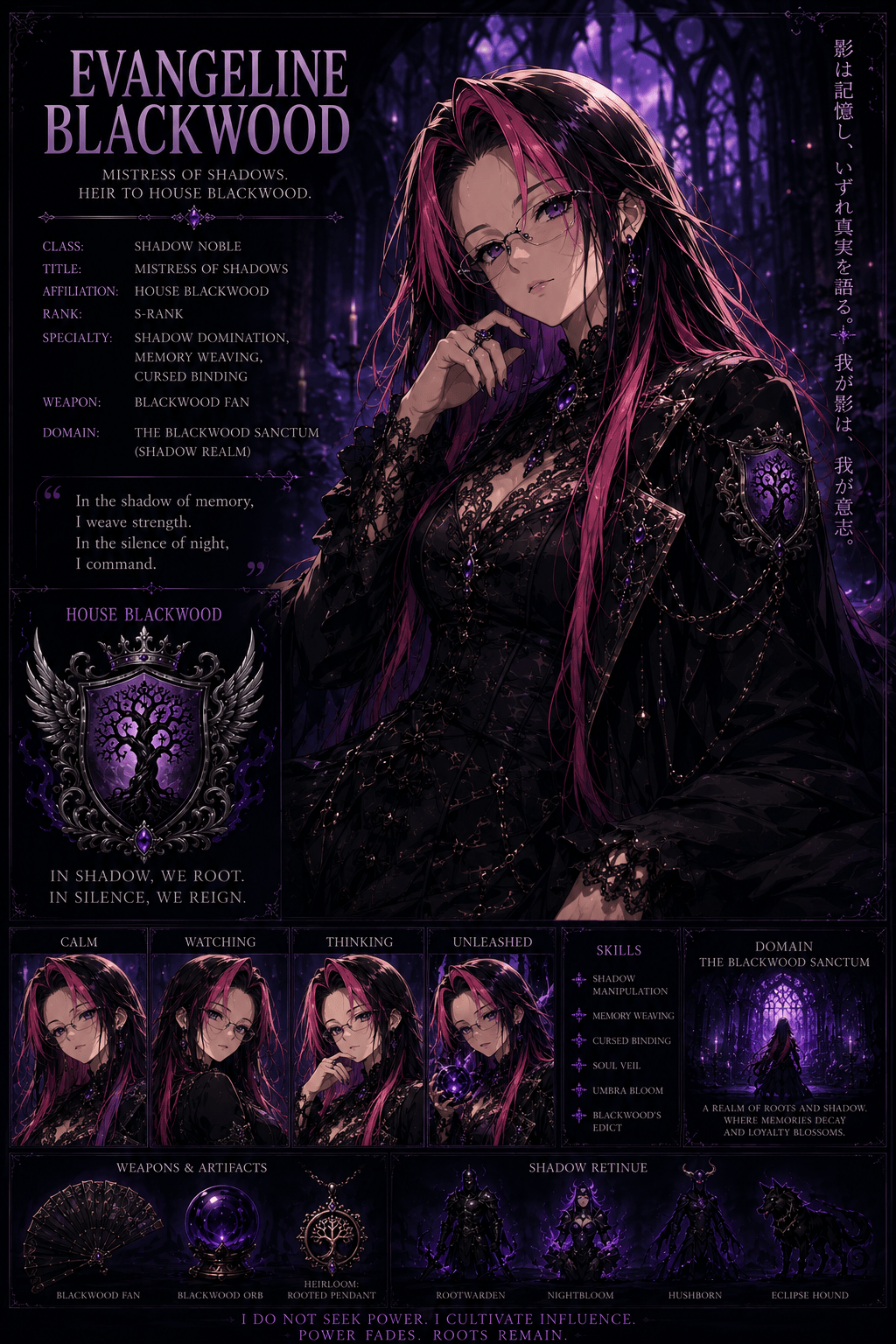
My name is Evangeline Genovia Marvolo Blackwood. I am the wife of Archduke Giovanni Lucio, the Queen’s second-eldest brother. Although I married into the Crown, the Holy Church does not recognize our union due to my husband’s previous divorces. Therefore, I do not hold the title of Archduchess.
Sigh.
What a mess I’m in.
I am the daughter of the celebrated court cook—and formerly notorious gambler—Lord Grey Blackwood and Lady Christiana Marvolo-Voss.
My father made his name as the favored chef of the royal court. Before King Rudolfo relinquished the throne, he rewarded my father’s service by bestowing upon him land and title.
My mother was beautiful, ambitious, and cunning. She married into the Blackwood family because of my grandfather’s military standing, believing she had elevated herself. In truth, she had married into a den of gamblers. All five Blackwood sons possessed some manner of gambling vice, and my father was no exception.
By the time my mother discovered the truth, it was too late.
She spent much of her married life working first as a tavern maid and later as a tavern owner. Eventually, she began an affair with the head of the Merchants’ Guild. He refused to leave his wife, however, as it was she who held the family title. My mother later met Duke Heratio Voss, a handsome, mid-ranking financier who openly fancied her. Once she had secured that relationship, she petitioned for an annulment from my father and left us behind to begin a new family of her own.
It took my father years to recover. He buried himself in his craft until his talent was discovered by Viscount Archibald Russ, a man who had King Rudolfo’s ear.
As the years passed, my father watched each of his four brothers suffer the same fate: marriages destroyed by their gambling addictions. The pattern finally sobered him. He lost his taste for games of chance and accepted that he was now responsible not only for his daughter’s survival but also for that of his brothers.
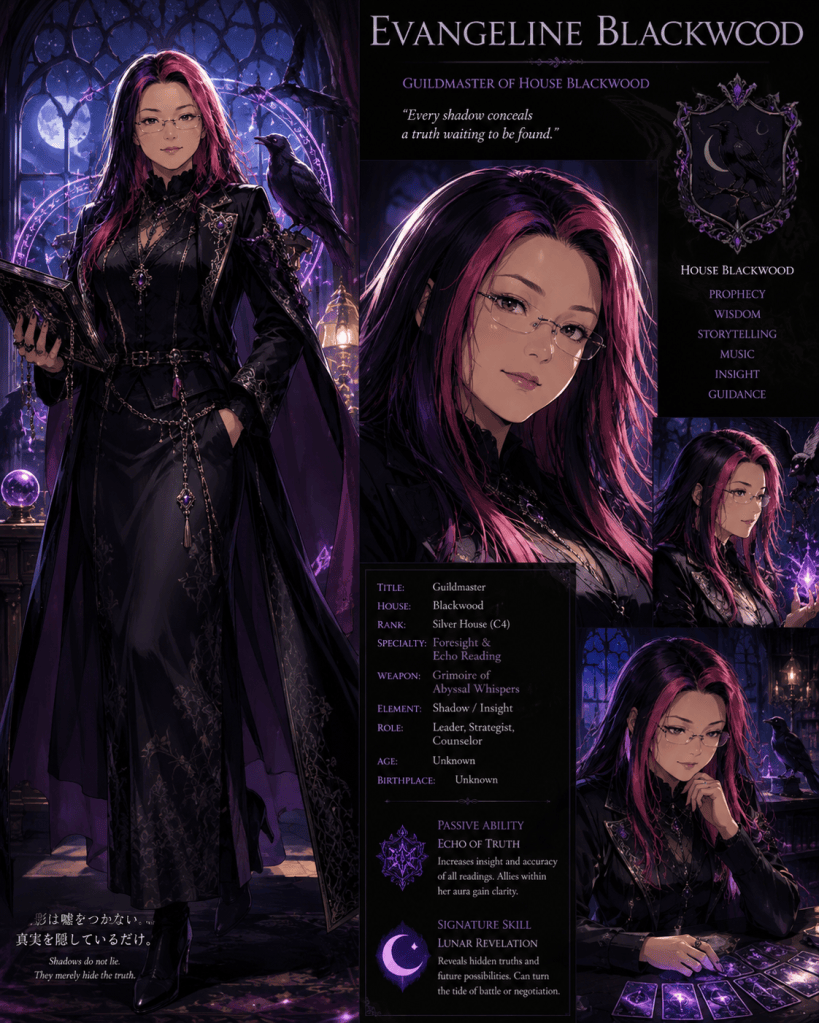
After leaving the royal court with his title and land, my father opened a tavern with an adjoining inn. I worked there beside him, and in time, it was discovered that I possessed gifts of my own—song and sight.
I could compose and perform songs that foretold romances, tournament outcomes, shifting political climates, and even the end of wars. My talent was fascinating enough to draw people in and terrifying enough to keep them listening. Soon, powerful men and women began visiting our tavern simply to hear me perform.
That was where Archduke Giovanni Lucio first met me.
He was fascinated by both my gift and my personality, and he soon became a frequent patron. It came as little surprise when, at thirty and five, I received an offer of marriage from him.
By then, I was considered an old maid, though I had been courted before. Unfortunately, none of my previous suitors possessed proper standing. Despite being only the daughter of a lord, I had a keen eye for making coin, and many of the men who pursued me were more interested in filling their coffers than winning my affection.
When the opportunity arose for me to marry into the Queen’s family, my father favored the match. He believed an archduke would possess the land, title, and wealth necessary to ensure that his daughter would always be cared for. In the beginning, I liked Giovanni and believed I might grow to love him. I also believed that marrying into the Queen’s family would ease the burden upon my father when I finally left his household.
Only later did we discover that it was all a lie.
The Crown recognized our marriage under civil law, but the Holy Church held final authority over the recognition of sacred unions and the inheritance of noble titles. Because Giovanni had already divorced twice, the Church refused to annul his previous marriage. I was therefore denied the title of Archduchess.
By law, I am Giovanni’s wife. In the eyes of the Church, however, I am not. Instead, I am regarded as an adulteress—a woman deceived into entering a royal marriage that the Church considers illegitimate.
Worse still, House Lucio was practically bankrupt. Only the grace of Her Majesty kept the family from becoming completely destitute.
I had indeed been married for my dowry.
My gift for song was hidden from the world for nearly a decade while I devoted myself to caring for my new family. Because God forbid a member of the royal family should be seen performing in a tavern.
And then my husband fell ill.
Giovanni was charismatic, but he was never a driven man. He preferred schemes promising quick coin to the burden of honest work and occasionally conducted business with merchants of questionable character. None of this was known beyond the Crown’s inner circle.
When a wasting illness robbed him of his strength, the responsibility for keeping House Lucio afloat fell to me.
I cared for him, and in the early years of our marriage, I did love him. But that love was gradually worn away by repeated disappointment and years of emotional strain. Because I was younger than Giovanni and possessed far less standing, everyone assumed that I should naturally become his caretaker, regardless of the cost to my own life. By then, my heart had grown cold.
I knew the time was drawing near when I would have to leave. My father offered me a room in his home and a means of escaping my marriage, but I understood what he could not say aloud: he was in no position to defy the Crown.
Then the Challenges of Wit began.
The Crown established the competition as a contest among the great Houses, though men and women from every walk of life—including nobles—were permitted to enter. The Challenges were considered more dignified than gladiatorial combat. They offered spectacle without bloodshed and generated far more coin for the royal treasury.
That lack of bloodshed also made nobles willing to participate, giving the common people a rare opportunity to watch society’s most dignified figures achieve glorious victory—or suffer exquisite humiliation—for their entertainment.
Although I still drew income from my family’s tavern and inn, their earnings were no longer sufficient to meet both my personal needs and the taxes and financial obligations imposed upon House Lucio by the Crown.
So I threw my hat into the ring.
The Queen opposed my participation, but there was little she could do. She knew the extent of House Lucio’s financial troubles. The alternative was allowing the public to discover that an archduke’s household was drowning in debt.
And so, after nearly a decade, I emerged from hiding.
By then, most people had all but forgotten me and my gifts. Yet within a few months, I began gathering momentum. My family’s tavern once again became the heart of my following, its patrons rallying behind me as I competed.
Before long, I reclaimed the only name that had ever truly belonged to me.
Lady Blackwood.


Leave a comment